Your First Dive Watch: A Beginner’s Guide to Getting It Right
So, you’ve decided to take the plunge. The allure of the dive watch has captured your imagination, and you’re ready to make one your own. Welcome. This isn’t just about buying a timepiece; it’s about acquiring a tool, a piece of history, and a daily companion that is as rugged as it is elegant.
The world of dive watches can seem as deep and mysterious as the oceans they were designed to explore. With a dizzying array of brands, specifications, and designs, where does a beginner even start? Fear not. This guide is designed to cut through the noise and help you find the perfect first dive watch—one you’ll cherish for a lifetime.
Why a Dive Watch?
First, let’s address the fundamental question: Why a dive watch for your first serious timepiece?
Quite simply, a good dive watch is arguably the most versatile watch category ever created. Born from a need for legibility and robustness in the most demanding environments, it brings that same reliability to everyday life. Its inherent characteristics—water resistance, a luminous dial, a scratch-resistant crystal, and a timing bezel—make it incredibly practical. Whether you’re actually diving, typing at a desk, gardening, or attending a semi-formal event, a dive watch fits the context with effortless style. It’s a tool watch that transcends its original purpose.
Decoding the Spec Sheet: What Really Matters
When you start looking, you’ll encounter a list of technical terms. Let’s break down the essentials.
1. Water Resistance: The “Dive” in Dive Watch
This is the most critical spec. While a watch labeled “200m” (or 20 BAR/ATM) is the official standard for a scuba diving instrument, for your first piece, anything from 100m to 300m is the sweet spot. A watch with 100m resistance is more than sufficient for swimming, snorkeling, and all daily accidents. The 200m-300m range offers peace of mind and is a hallmark of a true professional tool. Remember, this rating is for static pressure; the dynamic forces of moving in water are accounted for by these generous margins.
2. The Bezel: Your Elapsed-Time Computer
The rotating bezel is the dive watch’s defining feature and its most useful complication. It’s used to track elapsed time—critical for a diver’s bottom time, but equally handy for timing a parking meter, a conference call, or a perfect soft-boiled egg.
Look for a unidirectional bezel (it only rotates counter-clockwise). This is a crucial safety feature: if the bezel is accidentally bumped, it will only show that more time has passed, not less, preventing a diver from mistakenly thinking they have more air than they do.
Pay attention to the bezel action. It should turn with a satisfying, solid “click,” with no backplay. The insert can be made of aluminum (classic, can fade attractively over time) or ceramic (highly scratch-resistant, modern, and retains its color).
3. Legibility: Readable at a Glance, in Any Light
A dive watch must be instantly readable. This is achieved through:
- High-Contrast Dial: Typically a dark background (black, blue, green) with light-colored markers and hands.
- Lume: The photoluminescent material applied to the hands, markers, and often the bezel pip. Super-LumiNova is the modern standard and should glow brightly and consistently for hours. A quick test in a dark room will tell you everything you need to know about a watch’s lume quality.
- Clear Hands: Iconic shapes like the “Mercedes” hand, “Snowflake” hand, or broad “Sword” hand are designed for maximum visibility and distinction from the hour markers.
4. The Movement: The Heart of the Matter
The movement is the engine of your watch. You have two primary choices:
- Automatic (Self-Winding): The soul of a traditional dive watch. It’s powered by the motion of your wrist. An automatic movement connects you to the mechanical artistry of watchmaking. It will need to be worn regularly or stored in a watch winder to keep running, but it never needs a battery.
- Quartz: Powered by a battery. It is incredibly accurate, low-maintenance, and robust. Simply pick it up after months in a drawer, and it will show the correct time. For a pure, no-fuss tool watch, quartz is a brilliant and often underrated choice.
There is no “right” answer here. An automatic offers romantic, mechanical charm; a quartz offers absolute, set-and-forget reliability.
5. Case Material & Crystal: Built to Endure
- Case: Stainless steel is the classic, durable, and versatile choice. Titanium is lighter and highly corrosion-resistant but can scratch more easily. Both are excellent.
- Crystal: This is the clear cover protecting the dial. Sapphire crystal is the premium choice, being exceptionally scratch-resistant. Mineral crystal is a step down but still very good for the price. For a watch that will be a daily companion, sapphire is highly recommended.
Finding the Right Fit and Style
A spec sheet can only tell you so much. How the watch feels and looks on your wrist is everything.
- Case Size: Don’t be seduced by oversized trends. The classic dive watch size is between 39mm and 42mm. This range suits a vast majority of wrists. Pay more attention to the lug-to-lug measurement—this is the length from the top to the bottom of the watch. If this measurement is shorter than the width of your wrist, the watch will wear comfortably. A 40mm watch with a 48mm lug-to-lug will often wear better than a 42mm watch with a 50mm lug-to-lug.
- Bracelet vs. Strap: A metal bracelet is the classic pairing and is incredibly versatile. It can dress the watch up or down. However, don’t underestimate the comfort and style of a rubber strap or a synthetic fabric NATO/ribbon strap. They are perfect for actual water sports and offer a more casual look. The beauty of most dive watches is that they allow for easy strap changes, letting you create multiple personalities for your one watch.
Iconic Design Cues to Look For
As you browse, you’ll notice designs that have stood the test of time. You can’t go wrong drawing inspiration from these legends:
- The Submariner Template: The clean, balanced look with a black dial, Mercedes hand, and circular hour markers.
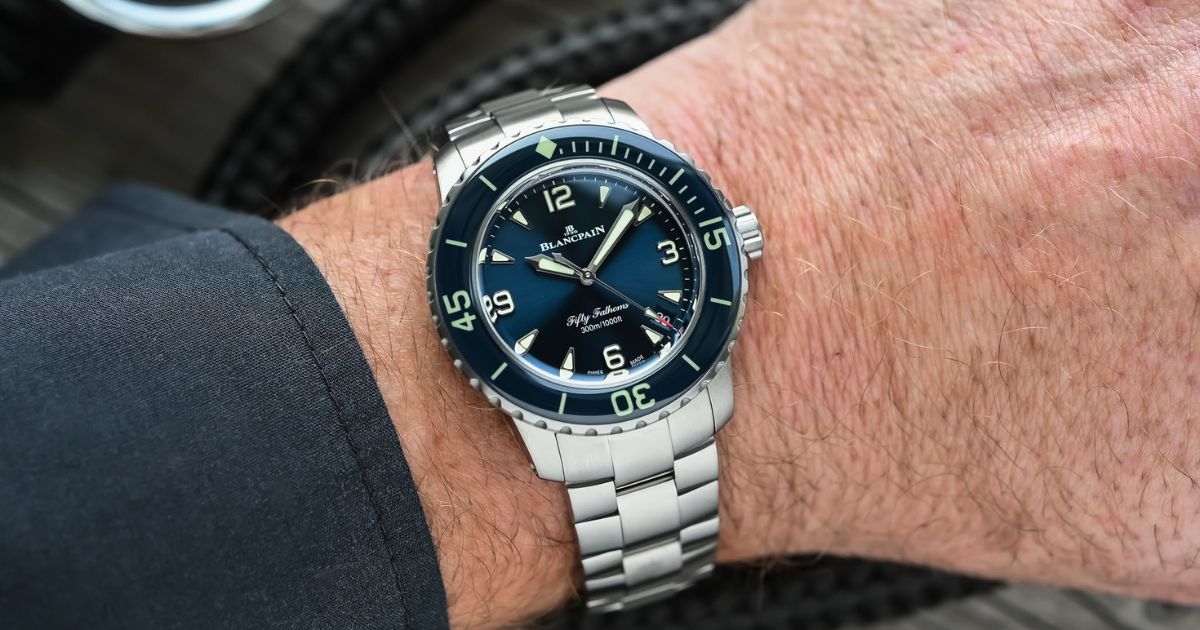
- The Fifty Fathoms Influence: The characteristic bezel with squared-off markers and a more minimalist dial.
- The Seamaster Flair: Wavy dials, helium escape valves, and skeletonized hands.
- The “Super Compressor”: A distinctive case with an internal rotating bezel controlled by a second crown.
Recognizing these lineages will help you understand what you’re naturally drawn to.
The Final, Most Important Consideration
With all this technical knowledge, the final decision comes down to a more personal question: Does it speak to you?
Does it make you glance at your wrist just to admire it? Does it feel like an extension of your personality? Your first dive watch is the start of a journey. It will be on your wrist for your triumphs, your adventures, and your quiet moments. It will gather scratches that tell your story.
Choose the one that you genuinely love, the one that makes you smile. Because the right dive watch isn’t just a tool for telling time; it’s a companion for making memories. Choose wisely, and wear it in good health.
About the author : Junior Darryl

Related Posts