The Story of Franck Muller: More Than Just a Crazy Name
If you’ve spent any time in the world of haute horology, you’ve seen them. They are impossible to miss. A watch with a case that defies all convention—curved, sculpted, and utterly distinctive. And then you see the name, often printed in an elegant, flowing script: Franck Muller.
But for many newcomers, the name itself can be a point of curiosity, even confusion. It sounds… well, almost normal, yet it’s attached to some of the most visually extravagant and technically brilliant timepieces ever created. The story of Franck Muller, however, is a tale that goes far beyond a memorable name. It’s a narrative of rebellious genius, artistic audacity, and a deep, profound respect for the highest traditions of watchmaking.
So, let’s pull back the curtain and discover why Franck Muller is a true master of modern horology.
The Genesis: A Restorer with a Revolutionary Spirit
Long before the “Master of Complications” became a global brand, Franck Muller was an individual—a brilliant, independent watchmaker. In the early 1980s, he graduated from the Geneva Watchmaking School and quickly made a name for himself not by creating new watches, but by resurrecting old ones. He specialized in restoring the most complicated vintage timepieces from the great houses like Patek Philippe and Vacheron Constantin.
This was his apprenticeship. Day in and day out, he handled the “greats,” deconstructing their most intricate secrets—perpetual calendars, minute repeaters, tourbillons. He didn’t just learn how they worked; he understood the why behind their design. This intimate, hands-on education with historical masterpieces gave him a foundation that few modern watchmakers possess. It was in this workshop, surrounded by the ghosts of horology past, that a revolutionary idea was born: to take these classical complications and reinterpret them for the contemporary world with a bold, new artistic language.
The Cintrée Curvex: An Icon is Born
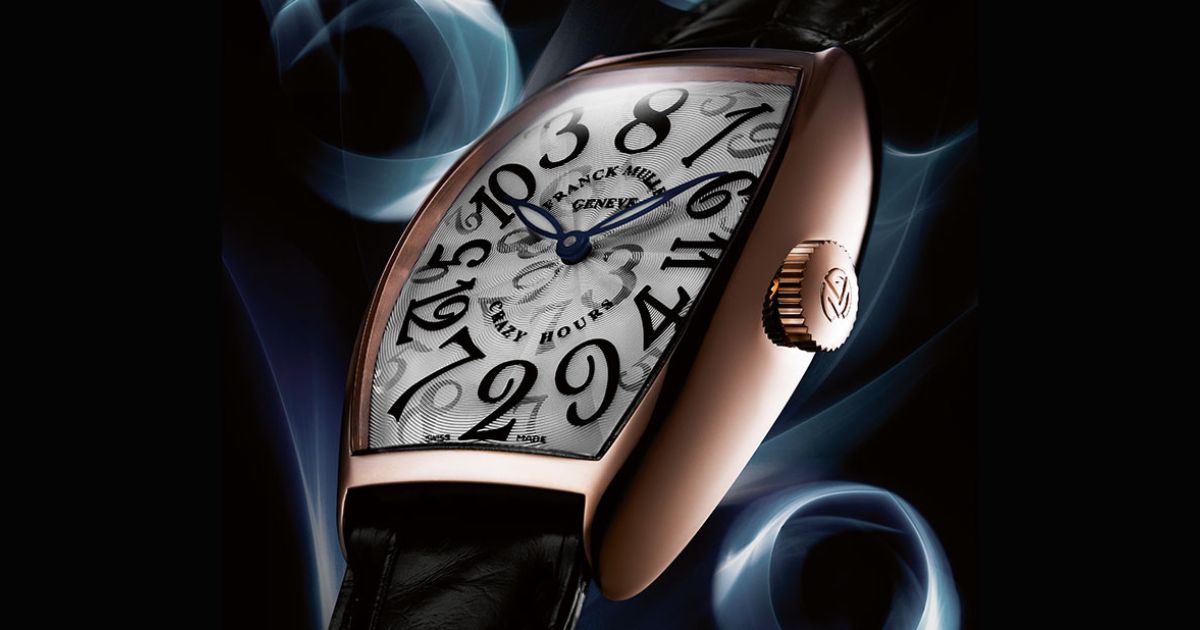
If there is one element that defines the visual identity of a Franck Muller watch, it is the Cintrée Curvex case. In an industry often dominated by round cases, Muller dared to be different. The Cintrée Curvex is not just an oblong shape; it is a complex, three-dimensionally curved case that is arched in both its length and width. This design isn’t merely for aesthetics—though it is stunningly beautiful.
The “cintrée” (curved) form was historically found in elegant, Art Deco-era timepieces. Muller took this classic concept and supercharged it. The Curvex case is designed to ergonomically hug the wrist, making it exceptionally comfortable to wear. More importantly, it became his canvas. This unique shape allowed the dial to be larger and more legible, providing a perfect stage for his complicated movements. It was a declaration that a high-complication watch didn’t have to be staid or conservative; it could be flamboyant, expressive, and sculptural. The Cintrée Curvex wasn’t just a case; it was a statement of intent.
The “Master of Complications” is Not a Marketing Slogan
Many brands use grandiose titles, but Franck Muller earned his. The title “Master of Complications” is backed by a staggering list of horological achievements. While the brand is now known for its bold designs, the heart of every Franck Muller watch is its movement—a marvel of micro-engineering.
Early in his career, Muller gained fame for creating the world’s first wristwatch with a Grande et Petite Sonnerie, a chiming complication so complex that even most established manufacturers hesitated to attempt it in a wristwatch. This was followed by a stream of world-firsts:
- Tourbillon with Perpetual Calendar: Combining two of watchmaking’s most revered complications.
- Revolution: The first triple-axis tourbillon, a mind-boggling innovation that countered gravitational error in three dimensions instead of one.
- Mega: A watch with the most complications ever assembled, featuring over 1,000 parts and 36 hands, indicating everything from the time of day to the seasons and celestial movements.
For a learner, the key takeaway is this: Franck Muller the brand did not become famous by just making pretty watches. It earned its stripes by pushing the boundaries of what was mechanically possible, often in a more public and dramatic way than the traditional, secretive Swiss manufactures.
The Art of the Dial: From Crazy Colours to Crazy Hours
A Franck Muller dial is a world of its own. The brand masterfully balances two seemingly opposite styles.
On one hand, you have the elegant, guilloché dials with classic Roman numerals—the “Banker” look. These pieces speak the traditional language of luxury, appealing to those who appreciate understated sophistication.
On the other hand, and perhaps more famously, are the vibrant, colorful, and playful dials. The use of bold colors, exotic materials, and artful designs makes these watches stand out in any crowd. This culminates in one of Muller’s most ingenious and fun complications: the Crazy Hours.
The Crazy Hours watch features a dial where the numerals are jumbled out of order. Yet, the hour hand doesn’t just point randomly; it jumps intelligently from one correct hour numeral to the next, while the minute hand continues its smooth sweep. It’s a complication that serves no practical purpose other than to delight, to surprise, and to remind the wearer that watchmaking, at its best, is a form of joy and magic. It perfectly encapsulates the brand’s philosophy: profound technical mastery should not preclude a sense of wonder and playfulness.
A Lasting Legacy: More Than a Name
The story of Franck Muller is a powerful lesson in modern horology. It teaches us that true innovation lies at the intersection of deep respect for tradition and the courage to challenge it. The brand took the most sacred complications from the vaults of watchmaking history and gave them a new, emotional, and artistic voice.
So, the next time you see a Franck Muller watch, look past the “crazy” name and the eye-catching design. Look at the gentle curve of the Cintrée Curvex, designed to fit the human form. Remember the restorer who became a revolutionary, the man who dared to make grand complications fun and fashionable without ever compromising on their technical integrity.
Franck Muller is not just a name on a dial; it is the story of a watchmaker who reminded the world that time, in its most exquisite form, can be a work of art. And that is a story worth telling.
About the author : Junior Darryl

Related Posts