A Crown For The Ages: The Complete History of Rolex
If you were to ask a person on the street to name a luxury watch, nine times out of ten, the answer would be “Rolex.” It is a name that has transcended the world of horology to become a universal symbol of achievement, precision, and enduring value. But how did a brand, founded in London in 1905 by a 24-year-old German man named Hans Wilsdorf, ascend to such mythic status? The story of Rolex is not one of chance, but a masterfully crafted narrative of innovation, marketing genius, and an uncompromising pursuit of perfection.
This is the complete history of the Crown.
The Foundation: A Vision for the Wrist (1905-1920s)
In the early 20th century, pocket watches were the norm, and wristwatches were considered fragile, unreliable novelties, primarily for women. Hans Wilsdorf, however, was a visionary. He believed in the potential of the wristwatch. His initial company, Wilsdorf & Davis, sourced high-quality movements from Switzerland and housed them in durable, elegant cases.
Wilsdorf had two obsessions: precision and reliability. In 1910, a Rolex watch became the first wristwatch in the world to receive the Swiss Certificate of Chronometric Precision, officially granted by the Official Watch Rating Centre in Bienne. Just four years later, in 1914, a Rolex wristwatch was awarded a Class “A” precision certificate by the Kew Observatory in Great Britain—an accolade previously reserved for marine chronometers. This was a monumental achievement that cemented Rolex’s reputation for accuracy.
The year 1919 saw a pivotal move as Wilsdorf relocated the company to Geneva, Switzerland, to escape post-WW1 taxation. But the most iconic moment was yet to come. In 1926, Rolex created a legend: the Oyster, the world’s first waterproof and dustproof wristwatch. Its secret was the patented “Oyster” case, featuring a system consisting of a screw-down bezel, case back, and winding crown. It was a sealed chamber, impervious to the elements.
Proof Through Adventure: The Marketing Masterstroke
A revolutionary product is nothing without proof. Wilsdorf, a marketing genius, found his proof in a feat of human endurance. In 1927, a young English swimmer named Mercedes Gleitze attempted to swim across the English Channel. Rolex equipped her with an Oyster. After more than 10 hours in the frigid, turbulent waters, she emerged—and the Rolex Oyster she wore was in perfect working order.
Wilsdorf seized this opportunity, buying the entire front page of the Daily Mail to announce the triumph of the “Rolex Oyster.” This was not just an advertisement; it was a story. It marked the beginning of Rolex’s foundational strategy: associating its timepieces with human achievement and real-world exploration.
The final piece of the puzzle came in 1931 with the invention of the Perpetual rotor. This self-winding mechanism, with a free-moving rotor that winds the mainspring with the natural motion of the wearer’s wrist, was a watershed moment. Combined with the Oyster case, it created the blueprint for the modern rugged luxury watch: the Oyster Perpetual.
The Tool Watch Era: Conquering Land, Sea, and Air (1950s-1960s)
The post-war era was Rolex’s golden age of innovation, where it didn’t just make watches; it created purpose-built tools for pioneers.
- The Explorer (1953): Born from the historic ascent of Mount Everest by Sir Edmund Hillary and Tenzing Norgay, the Explorer was a model of rugged simplicity, legibility, and reliability in the most extreme conditions.
- The Submariner (1953): The watch that defined the dive watch category. With a rotating bezel to track immersion time and an unprecedented water resistance of 100 meters (later increased vastly), it became the professional diver’s instrument and, later, an icon of style.
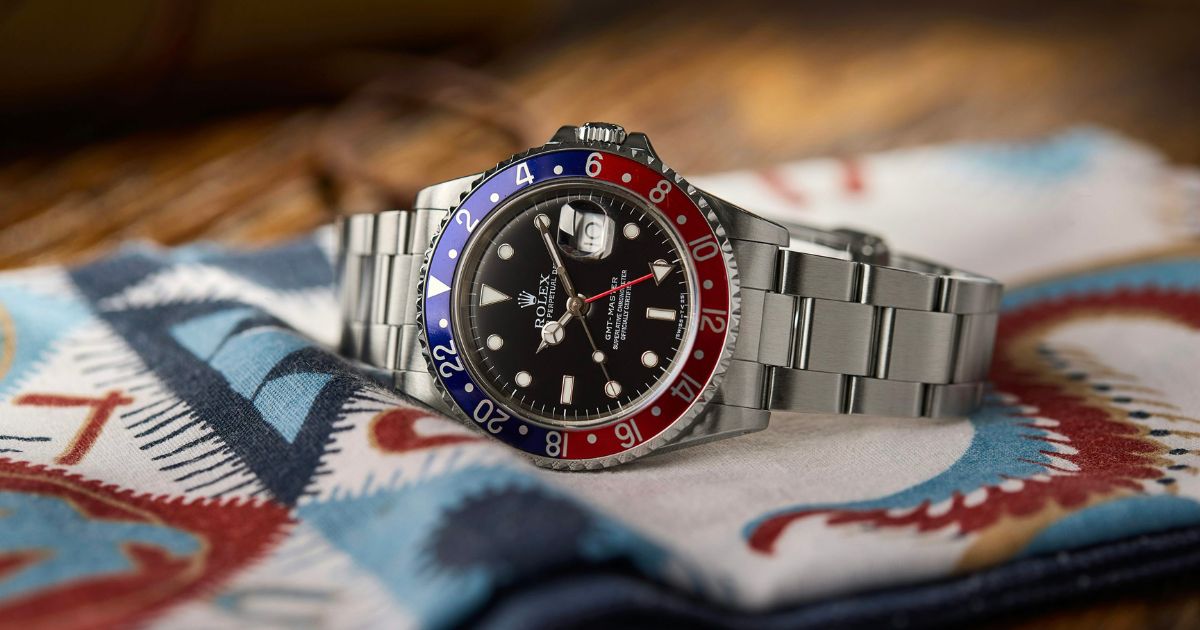
- The GMT-Master (1955): Created in collaboration with Pan American Airways, the GMT-Master, with its distinctive two-colour “Pepsi” bezel and an additional 24-hour hand, allowed pilots to read two time zones simultaneously, a crucial tool for transcontinental jet-age travel.
- The Day-Date (1956): A statement of prestige. Upon its launch, the Day-Date was the first wristwatch to display the date and the full day of the week spelt out in its entirety. Crafted only in precious metals and famously worn by world leaders, it earned its nickname, the “President.”
Consolidating an Icon: The Pursuit of Perfection (1970s-Present)
Rather than resting on its laurels, Rolex continued to refine and redefine its classics. The 1970s saw the introduction of the Sea-Dweller, a hyper-specialized diver for saturation divers, and the Explorer II, with its fixed 24-hour bezel for cavers and polar explorers.
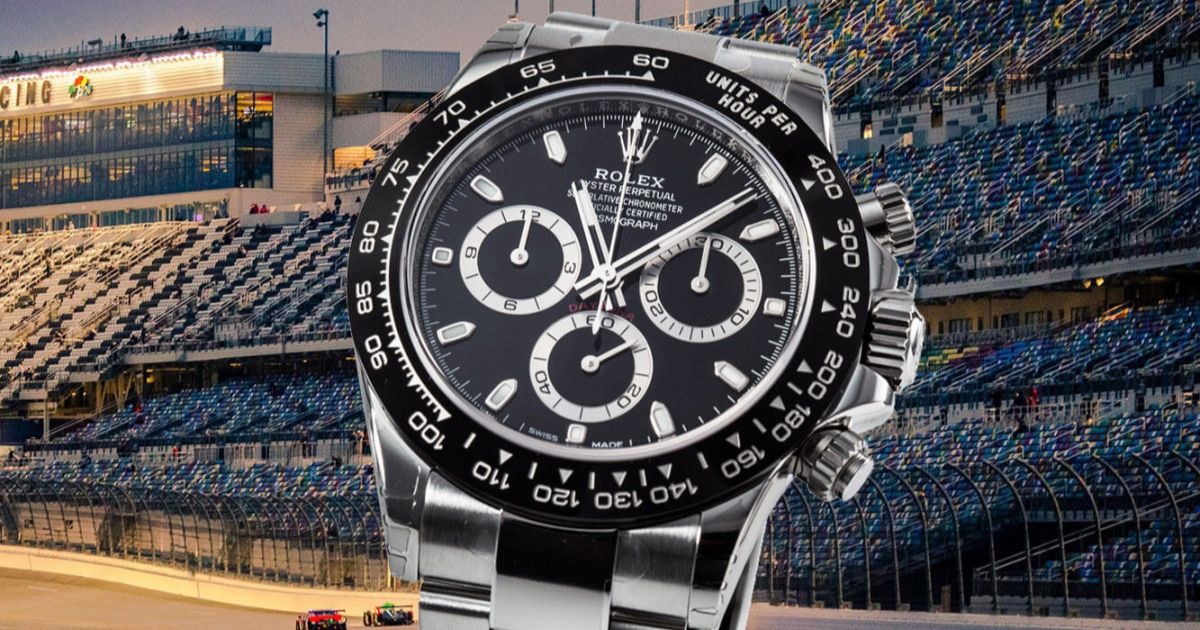
Perhaps the ultimate symbol of this relentless refinement is the Cosmograph Daytona, launched in 1963. While its early years were quiet, its association with motorsport and a certain Paul Newman catapulted it into the stratosphere, making it one of the most coveted and legendary chronographs ever made.
Rolex’s philosophy is one of vertical integration and obsessive control. The brand produces its own gold alloys, like the uniquely warm Everose gold. It crafts its own ceramics for bezels, known as Cerachrom. And perhaps most importantly, it developed and manufactures all of its own movements, all of which are certified as Superlative Chronometers, a standard that far exceeds the industry norm.
The Crown Today: A Legacy Unmatched
Today, a Rolex is more than a timepiece; it is a cultural artifact. It is the watch of James Bond and Sir Jackie Stewart. It is on the wrists of concert cellists, groundbreaking scientists, and visionary entrepreneurs. It is a reward for a lifetime of hard work and a heirloom passed to the next generation.
The history of Rolex is a masterclass in brand building. It is a story where legendary marketing was always backed by genuine, groundbreaking innovation. From the depths of the Mariana Trench to the peak of Everest and the boardrooms of the world, Rolex has not just kept time; it has chronicled human progress. It is, truly, a crown for the ages.
About the author : Junior Darryl

Related Posts